Signs you need this
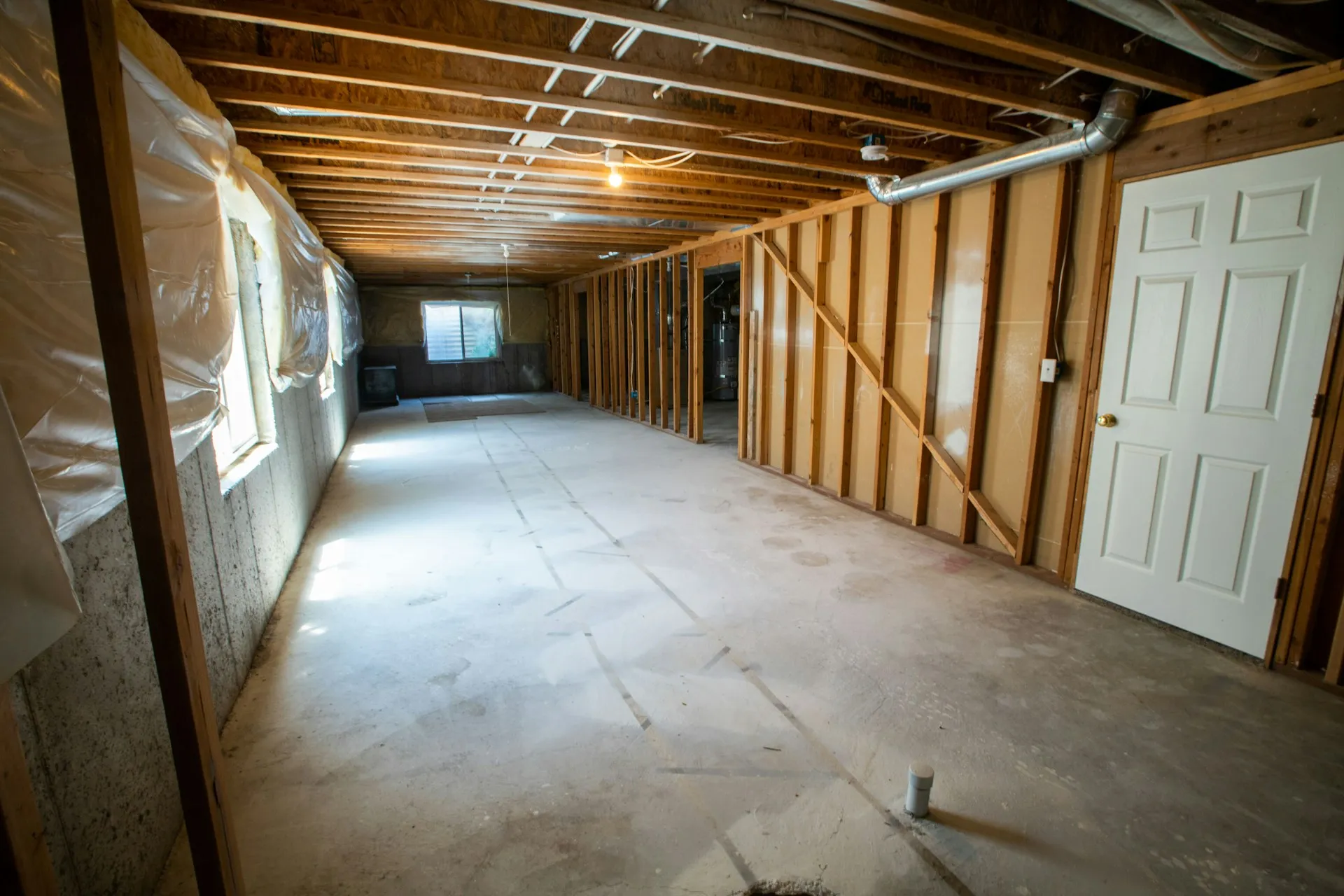
- • A large unfinished basement — bare block walls, exposed framing, no ceiling
- • Framing is up and rough-in is done, but no board has been hung yet
- • A basement drywalled with standard board years ago now bubbling or molding at the base
- • A home bought with an unfinished basement you want to complete
- • Usable square footage going to waste — a potential office, media room, gym, or guest suite
What the service involves
Basement drywall finishing converts unfinished below-grade space to finished living area — a permitted project that runs through framing, electrical, and HVAC rough-in inspections before drywall. We install moisture-resistant board on all below-grade walls as standard practice, spec a Type X assembly on any garage common wall, and coordinate the sub-permit and drywall inspection with the Stamford Building Department.
The permit and inspection sequence
Connecticut requires a building permit for any basement conversion to finished living area. The sequence is fixed: permit application → framing inspection → electrical rough-in inspection → HVAC rough-in inspection → drywall hangs. Each inspection has to be signed off before the next trade can close up, and drywall can’t go up until the electrical and HVAC rough-in passes are on record. We pull the drywall sub-permit and coordinate our inspection with the Building Department — this is paperwork we handle, not work we hand back to the homeowner or GC.
Moisture-resistant board: the only correct choice for below-grade walls
The failure mode for standard drywall in a below-grade application is vapor migration, not a visible leak. Moisture moves through concrete walls and floor slabs even in basements that appear completely dry. Standard drywall paper face absorbs that moisture vapor over time and begins to delaminate and mold within two to four years — you won’t see it until it’s already a remediation problem.
We install USG Sheetrock PURPLE, National Gypsum Gold Bond eXP, or CertainTeed GlasRoc on all below-grade wall sections. These products use fiberglass facing instead of paper, which removes the primary moisture pathway into the core. They cost more per sheet than standard board; they’re the correct material for the application. This is not an upsell — it’s standard scope on every basement we finish.
Type X on the garage common wall
If the finished basement space connects to an attached garage, the common wall requires a Type X fire-rated assembly under Connecticut building code. Typically 5/8” Type X drywall on the garage-side wall, taped and finished. The ceiling above a habitable room over a garage also requires 5/8” Type X. This is an inspection item — the Building Department will flag a non-compliant common wall during the drywall inspection.
Finish level by room
Most basement rooms finish to GA-216 Level 4: all seams taped and feathered, fasteners covered, surface consistent and ready for paint. Home offices, media rooms, and in-law suites where the finish needs to match the upstairs standard may warrant Level 5 — a full skim coat — in the main rooms. Utility areas and mechanical rooms are typically left at Level 3. We confirm the required level for each room in the quote.
Egress for bedrooms
Bedrooms in a finished basement require an egress window — minimum opening dimensions required by Connecticut building code and the IRC. If egress hasn’t been addressed and a bedroom is in the plan, it’s a conversation to have at the permit stage, not after the board is up. We flag this during the initial walkthrough.
Materials & standards
Products & materials we use
- USG Sheetrock PURPLE (moisture-resistant; below-grade walls)
- National Gypsum Gold Bond eXP (moisture-resistant alternative)
- CertainTeed GlasRoc (fiberglass-mat board)
- Type X drywall (garage common wall)
- QuietRock 510 / 530 (soundproof panel where specified)
Standards & codes we work to
- GA-216 finish levels (Level 4 / 5)
- CT State Building Code (basement conversion permit)
- UL fire-resistance design (garage common wall)
- IBC Section 302 (garage occupancy separation)
What the terms mean
- Below-grade wall / MR board
- Fire blocking at top plate
- Backing / blocking
- Sub-permit
- Fastener schedule
- Rough-in inspection
- Egress window
Options & variants
| Option | When it applies | Cost |
|---|---|---|
| Board, tape, and finish only | Framing complete and rough-in signed off; we take over at the drywall phase | Lower |
| Full drywall scope with GC coordination | GC manages framing and rough-in; we sub the drywall and coordinate inspections | Mid |
| Partial finishing (one room) | One room finished while the rest stays unfinished mechanical/storage | Lower; permit still required |
| Garage-adjacent (fire-rated assembly) | Basement shares a wall or ceiling with an attached garage — Type X required | Higher |
| High-finish scope (Level 5) | Media room or in-law suite where Level 5 is specified | Premium |
What affects cost
- • Total wall and ceiling square footage — the primary variable.
- • Ceiling height — 9–10 ft ceilings (common in North Stamford colonials) raise board count and labor.
- • Moisture-resistant board throughout below-grade walls — our standard; adds material cost over standard drywall.
- • Garage common wall — a fire-rated Type X assembly adds material and labor where present.
- • Number of rooms and layout complexity — more headers, corners, and returns than an open-plan finish.
- • Backing for built-ins and fixtures — blocking installed at correct heights before board goes up.
- • Finish level — Level 5 adds a full skim pass for rooms taking flat or matte paint.
- • Permit coordination — pulling the sub-permit and scheduling the drywall inspection is included in our scope.
Price ranges
Low end
$2,500–$5,500
Smaller basement or single-room finish, MR board on below-grade walls, standard 8 ft ceiling, Level 4, permit coordination included.
Typical
$4,000–$9,000
Full footprint 800–1,500 sq ft, MR below-grade walls, normal ceiling height, Level 4, permit and inspection coordination.
High end
$6,000–$18,000+
Large North Stamford basement (1,500+ sq ft), 9–10 ft ceiling, multiple rooms, garage fire-rated wall, built-in backing, Level 5 in one room.
What to expect
- 1
Site assessment
We measure wall and ceiling footage, check ceiling height and framing, identify below-grade walls and any garage common wall, and confirm prior inspections are signed off.
- 2
Permit scope clarification
We confirm the building permit is pulled (or advise pulling one) and map the inspection sequence before scheduling the drywall phase.
- 3
Quote
Itemized: wall footage (MR board), ceiling footage, finish level, backing scope, permit coordination, and garage wall assembly if applicable.
- 4
Sub-permit pull
We pull the drywall sub-permit with the Stamford Building Department and schedule the inspection — the homeowner or GC doesn't manage this.
- 5
Backing installation
Blocking installed for cabinetry, shelving, fixtures, and TVs before any board goes up; locations confirmed first.
- 6
Board hang
MR board on all below-grade walls, standard board at the ceiling, Type X at any garage common wall; correct fastener schedule and fire blocking.
- 7
Tape and finish
Level 4 throughout — paper tape, three coats, sanded smooth; Level 5 where specified. We don't rush the mud schedule.
- 8
Drywall inspection
We meet the inspector on-site; correct board type, fastener schedule, fire blocking, and backing are checked. Built to pass the first time.
- 9
Prime and handoff
After sign-off, surface primed and handed off paint-ready, with permit documentation for your records.
When this isn’t the right call
- If moisture is actively coming through the foundation → waterproofing comes first; no drywall holds up over active water intrusion.
- If framing, electrical, or HVAC rough-in isn't signed off → drywall legally can't go up yet; starting early risks a failed inspection and tear-out.
- If only part of a large basement is being finished → partial finishing is fine, but the permit must reflect the correct scope.
- If the conversion involves structural changes → moving load-bearing walls or adding egress windows must be inspected before drywall.
- If it's a light cosmetic repair in an already-finished basement → see drywall repair & patching; full finishing scope isn't needed.
Frequently asked questions
Do I need a building permit to finish my basement in Stamford? +
Yes. Connecticut requires a permit to convert unfinished basement space to finished living area — any habitable room, office, gym, or bedroom. The sequence covers framing, electrical rough-in, HVAC rough-in, and drywall before the final inspection. We can advise on the process and pull our own drywall sub-permit; the overall permit is typically pulled by the homeowner or GC.
What's the inspection sequence, and where does drywall fit in? +
Stamford inspects in order: framing, electrical rough-in, HVAC rough-in (if new ductwork), then drywall. Board can't go up until framing, electrical, and HVAC rough-in are signed off. After drywall comes a final inspection once finish work is complete. We coordinate the drywall inspection and won't start board until the prior sign-offs are in hand.
What does the Stamford drywall inspector check? +
Correct board type per location (moisture-resistant on below-grade walls, Type X at any garage common wall), fastener schedule, fire blocking at the top plate, and backing at panel joints. We install to that standard on every job so the inspection passes without a callback.
Why moisture-resistant board instead of standard drywall? +
Below-grade walls let moisture vapor migrate through the assembly even with no visible leak. Standard drywall's paper face delaminates and molds within 2–5 years in most Fairfield County basements. MR board (USG Sheetrock PURPLE, National Gypsum Gold Bond eXP, CertainTeed GlasRoc) uses a fiberglass or coated face that resists it. We use it throughout below-grade walls as standard practice, not an upsell.
My basement has an attached garage on one side. Does that change anything? +
Yes. The wall and/or ceiling shared with an attached garage requires a fire-rated assembly — typically 5/8-inch Type X on the garage side, and 5/8-inch Type X on the ceiling if there's habitable space above. We identify the garage common wall at assessment and include the correct assembly in the quote. Standard board there is a failed inspection.
What's the difference between a Level 4 and Level 5 finish, and which do I need? +
Both are GA-216 standards. Level 4 — joints, fasteners, and corners covered, smooth under standard latex — is right for most basement walls and ceilings. Level 5 adds a full skim coat over the entire surface and is the call for rooms using flat or matte paint or with raking light, like a media room with sconce lighting. We discuss finish level per room at the quote.
What does it cost to finish a basement in Stamford? +
A typical full-basement project — 800–1,500 sq ft, MR board on below-grade walls, standard ceiling, Level 4, permit coordination — runs $4,000–$9,000. Large North Stamford basements with high ceilings, multiple rooms, or a garage fire-rated wall run $6,000–$18,000+. A single-room finish can come in at $2,500–$5,500. The most accurate number comes from an on-site measurement.
Can you start right away, or do I need the permit in hand first? +
The permit needs to be in hand before framing and rough-in, and the prior inspections signed off before we hang board. We can quote and schedule while the permit is in process, but we won't begin without a permit or hang board before the inspection sequence is at the right stage.
Do you work with general contractors, or only homeowners? +
Both. We work directly with homeowners and as a drywall sub on a GC's schedule — coordinating the inspection sequence, the sub-permit, and the electrical and HVAC trades. We're used to being one trade in a coordinated sequence without creating scheduling problems.