Signs you need this
- • A commercial buildout needs interior partitions framed before drywall
- • Tall or high-bay walls that standard office framing will not hold straight
- • Walls that carry lateral load or support overhead elements
- • A buildout where blocking for cabinets, fixtures, or equipment has to be set before board
What the service involves
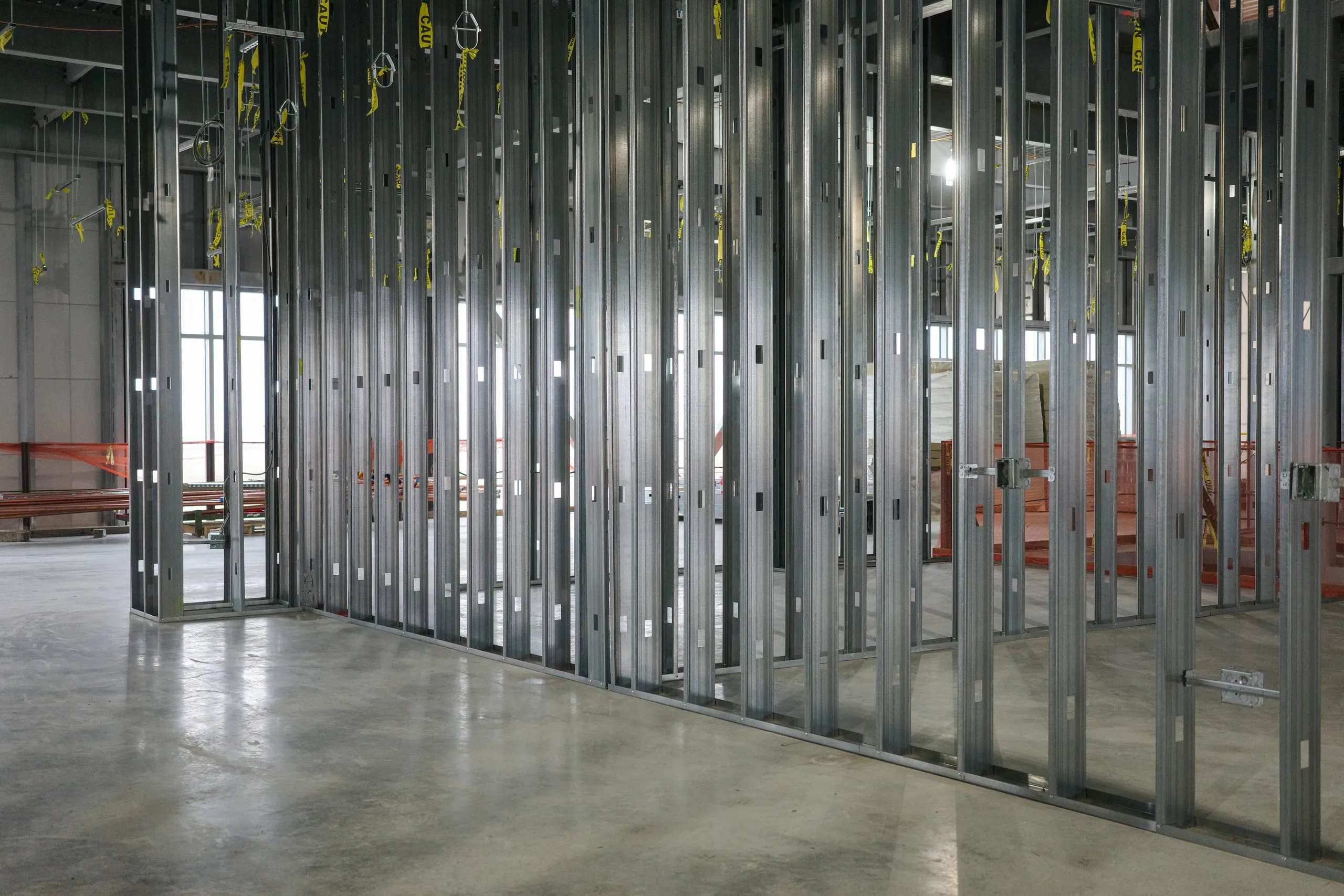
Steel-stud framing is the skeleton every commercial wall is built on, and the quality of the framing sets the ceiling on the quality of the finish. A partition framed in the right gauge, spaced correctly, and detailed for deflection at the deck gives the drywall a flat, rigid, stable surface to live on. A partition framed wrong does the opposite, and no amount of taping skill fixes a wall that is moving or out of plane.
Gauge follows the wall
The single most important framing decision is gauge, and it follows the wall rather than a house default. Standard floor-to-ceiling office partitions are framed in 25-gauge stud. The moment a wall gets taller, carries lateral load, or supports overhead elements, we move to 20-gauge or heavier and tighten the spacing. In Stamford that range runs from standard downtown office partitions to high-bay industrial walls near the water that climb well past office height, and the same job can need both. We confirm the gauge and the spacing against the drawings and the wall conditions before we order steel.
Deflection at the deck
Buildings move, and a wall fastened rigidly top and bottom will telegraph that movement as cracked finish. We detail the top track so the partition is held in plane but free to move vertically as the deck deflects. On a tall wall that detail is not optional, it is the reason the finish survives the first heating season. It is also the kind of detail that is invisible once the board is up, which is exactly why it gets skipped by framers who are not thinking about the finish.
Blocking before the board
Anything that hangs on a wall needs solid backing behind it, and that backing has to go in before the drywall closes the wall. We set blocking for upper cabinets, wall-mounted screens, grab bars, fixtures, and equipment, confirmed against the drawings and the equipment layout. Blocking caught after the fact means cutting a finished wall back open, so we treat the blocking pass as part of the framing, not an afterthought.
Framing for rated assemblies
When a wall is a fire-rated assembly, the framing is dictated by the UL design number, the stud gauge, the spacing, and the detailing are all part of the tested system. We frame rated walls to the exact design rather than to a generic tall-wall standard, because the rating depends on it and an inspector will check it before the wall is covered. Where the rated assembly is part of a larger buildout, we coordinate the framing and the inspection so the drywall scope behind it stays on schedule.
Materials & standards
Products & materials we use
- 25-gauge steel stud and track for standard partitions
- 20-gauge and structural-gauge stud for tall or loaded walls
- Deflection track for top-of-wall detailing
Standards & codes we work to
- AWCI commercial drywall and framing standards
- UL Fire Resistance Directory design numbers for rated framing
- CT State Building Code 2022
What the terms mean
- Steel-stud gauge, 25 and 20 gauge
- Top-track deflection detail
- Lateral load and load-bearing partition
- Blocking and solid backing
Options & variants
| Option | When it applies | Cost |
|---|---|---|
| Standard office partition framing | Floor-to-ceiling office and conference walls at standard height | 25-gauge, standard spacing |
| High-bay and structural-gauge framing | Tall industrial or warehouse partitions, load-bearing or overhead-supporting walls | 20-gauge or heavier, deflection detailing |
| Fire-rated assembly framing | Demising walls and rated separations where the UL design dictates the framing | Per the UL design number |
What to expect
- 1
Drawing and scope review
We confirm partition layout, wall heights, gauge, and where fire-rated or acoustic assemblies apply from the drawings.
- 2
Layout
We lay out the partitions on the slab and confirm against the other trades before track goes down.
- 3
Track and stud
Bottom track fastened to the slab, top track detailed for deflection, studs set at the spacing the wall requires.
- 4
Blocking
Blocking set for cabinets, fixtures, grab bars, and wall-mounted equipment before the board closes the wall.
- 5
Inspection coordination
Where framing or fire-rated inspections are required, we coordinate them before drywall covers the work.
When this isn’t the right call
- If the project is residential, wood framing is usually the right fit and commercial steel-stud systems do not apply.
- If the wall is a standalone fire-rated assembly without a buildout, see fire-rated drywall assembly for that scope.
- If you only need the drywall hung and finished over existing framing, that falls under the finishing scope, not framing.
Frequently asked questions
What gauge steel stud do you use? +
It depends on the wall. Standard floor-to-ceiling office partitions are 25-gauge. We move to 20-gauge or heavier for taller walls, walls that carry lateral load, and walls that support overhead elements. The gauge is a structural decision driven by height and load, not a default, and getting it wrong is what makes a finished wall wave or crack.
Why does deflection detailing at the top matter? +
Buildings move, and a partition fastened rigidly top and bottom will crack the finish when the structure deflects. We detail the top track so the wall is held in plane but can move vertically with the deck. On taller walls that detail is the difference between a finish that lasts and one that cracks in the first season.
Do you set the blocking for cabinets and equipment? +
Yes, and it has to happen before the board goes up. We set blocking for upper cabinets, wall-mounted screens, grab bars, fixtures, and anything that needs solid backing, confirmed against the drawings and the equipment layout. Blocking missed before the wall closes means opening the wall back up later.